Things to Do in Boa Vista, Cape Verde: Dunes, Beaches, Wildlife
Boa Vista is the big, empty, sandy island. This guide groups its beaches, dunes, wreck and wildlife by interest, gives the official watching rules, and flags what the island does not offer.
By Cape Verde 365 Editorial Reviewed by Alex Borshch, Founder & Editor
Published November 16, 2026 · 9 min read
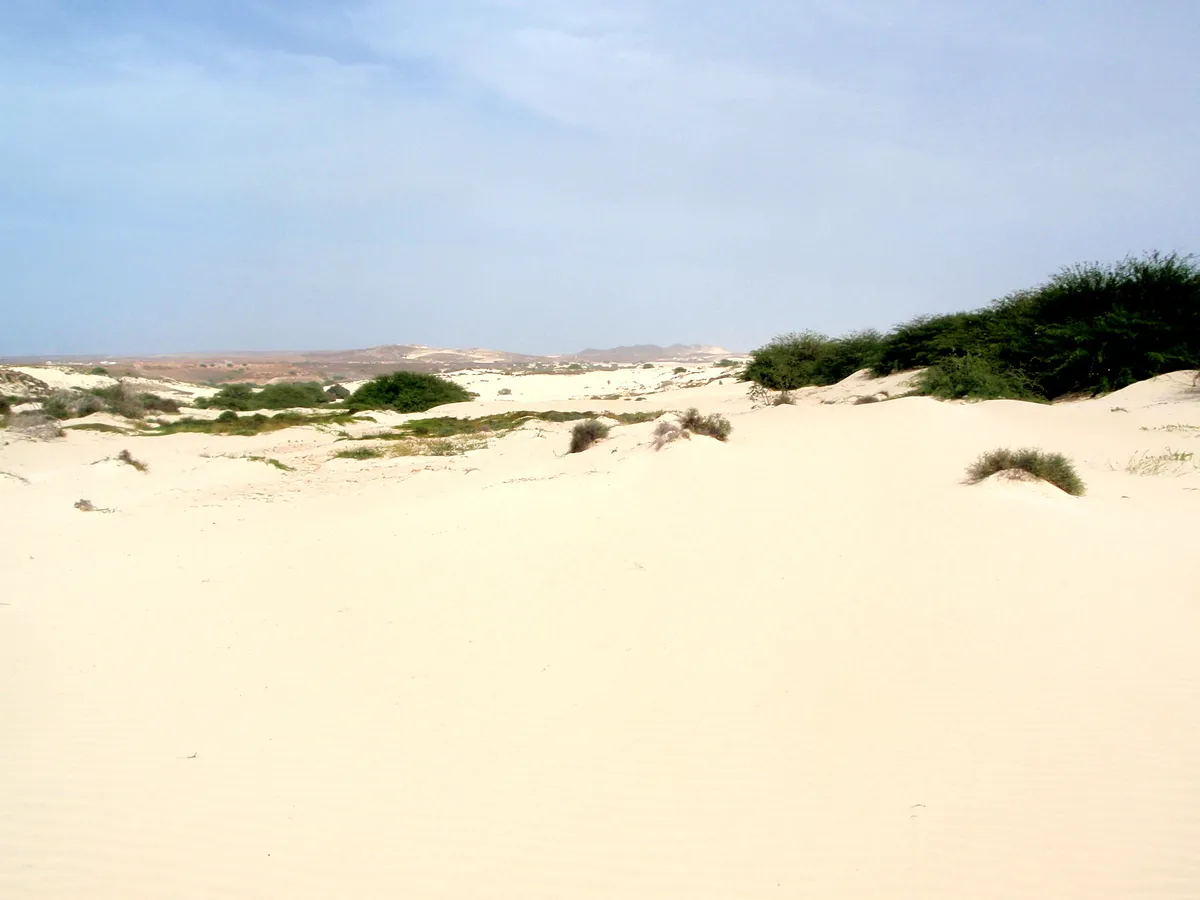
Boa Vista is one of the emptiest islands in Cape Verde. It is mostly sand and stony plain, ringed by long beaches, with the town of Sal Rei, on the west coast and its international airport, Aristides Pereira International (BVC), a short drive away. Most visitors come for the beaches and the dunes, and that is a fair summary of what this corner of Cabo Verde, to give the country its official name, does best. Below, the island's sights are grouped by interest, with turtle-watching rules and whale-watching guidance and a straight answer on what Boa Vista is not good for.
Beaches
Boa Vista's beaches are long, wide and, away from the resorts, often empty. Four are worth knowing by name.
- Praia de Chaves: a broad beach backed by dunes south of Sal Rei, with resort hotels at one end and open sand beyond.
- Praia de Santa Mónica: a very long beach on the south-west coast, quiet and remote once you walk away from the resort stretch.
- Praia de Estoril: the town beach of Sal Rei, handy for a swim, a drink and the water sports centres.
- Praia da Varandinha: a rocky, dramatic stretch of coast in the south-west, better for walking and photographs than for a beach day.
Size has a downside: do not assume that a remote beach has a lifeguard, shade or phone reception. The UK government's travel advice warns that tides and currents around the islands are very strong and that waves can have a strong undertow, and tells visitors to use beaches where a lifeguard is on duty. Check that a lifeguard is actually on duty rather than assuming hotel or town beaches are supervised. Treat remote beaches as walks, not swims.
Dunes and desert
The Viana desert (Deserto de Viana) inland from Sal Rei is a field of pale dunes that looks more Saharan than Atlantic. Consider it for desert and dune tours by 4x4, quad or on foot with a guide. Go early or late in the day: the sand is hot by midday and the light is flat.
The dunes of the Morro de Areia nature reserve are a designated Natural Reserve in the country's national network of protected areas. Several of Boa Vista's protected areas are dunes and beaches used by nesting turtles, and Project Biodiversity lists quads and cars on the sand among the activities that destroy dune habitat. If you book a motorised tour, choose one that keeps to tracks, and stay off the dunes on nesting beaches.
Wind is part of the desert experience. The UK advice says sandstorms (bruma seca) can happen between December and February and that, when intense, they can disrupt air travel, especially on Boa Vista. A hazy day is a poor day for dune photographs, so keep your tour date flexible if you can.
The Cabo Santa Maria shipwreck
The rusting hull of the Cabo Santa Maria, a cargo ship that ran aground on the north coast, is one of the island's sights. It sits just off a wide, windswept beach and can be combined with the Viana desert on a northern island tour. The wreck is breaking up: look from the sand, do not climb on it, and do not swim out to it, because the surf and currents along this coast are strong.
The north of the island also holds the Boa Esperança Natural Reserve, another protected area in the national network. Expect rough tracks rather than roads, and consider a guided trip if you are unfamiliar with the route.
Turtle watching
Boa Vista is one of the islands that make Cape Verde globally important for loggerhead turtles. Project Biodiversity notes that the beaches of Sal, Boa Vista and Maio have significant nesting populations and says the archipelago is the world's third-largest loggerhead nesting site. Nesting walks are therefore a summer highlight, and they are tightly regulated.
The charity gives the official observation dates for 2026 as 1 July until the end of September, excluding specific nesting beaches. Under the national turtle watching regulation (Decreto-lei n.º 50/2024), visitors may only use red-light torches, with white light and flash banned; a group of no more than ten visitors approaches each turtle in a line behind the nature guide; and visitors may never be left alone on the beach. Book turtle watching through a guided excursion and do not walk nesting beaches with a torch on your own.
Whale watching
Humpback whales come to Cape Verde's waters to breed and calve, and the waters around Boa Vista are among the best known for sightings. A good-practice guide for nature excursions, validated by the national environment and tourism directorates, says two humpback populations use the islands: the North Atlantic one from February to May and a Southern Hemisphere one from July to October. For a winter or spring holiday, the February to May window is the one that matters.
The same guide sets a watching zone of at least 60 metres from the whales, rising to 100 metres when calves are present, with a limit on total time spent with them. A good whale watching operator will brief you on this before leaving port and will not chase animals for a photograph.
Wind and water sports
Boa Vista offers wind sports around Sal Rei. Kitesurfing and windsurfing schools work from the bay at Sal Rei, where you should ask about the conditions on the day. Experienced riders head for wilder spots with a guide. Surfing depends on swell and calls for advice from a qualified instructor.
Under the water, scuba diving and snorkelling trips leave from Sal Rei and the resorts, and sport fishing boats go out for bigger fish offshore. Check the sea state before booking.
Sal Rei: the town
Sal Rei is small, walkable and a base for seeing everyday Cape Verdean life. Spend an evening around the main square and the streets behind the seafront, where small restaurants serve cachupa, fresh fish, grilled lobster when it is in, and goat's cheese, queijo de cabra, often with papaya jam. Bars sometimes have live music, and a glass of grogue or ponche finishes the night.
Offshore, the islet facing the town is protected as the Monte Ilhéu de Sal-Rei Natural Monument. Other protected sites dot the island, among them the Ponta do Sol Natural Reserve and the Rocha Estância and Monte Santo António natural monuments. A guided island tour is the easiest way to see a few of them.
What Boa Vista is not good for
- Exploring on your own. Distances are long and much of the island is reached on sand or stony tracks. A guided tour or a driver is usually more practical than a hire car.
- Nightlife and choice. Outside the all-inclusive resorts and Sal Rei, there is very little. If you want a lively town with lots of restaurants, Santa Maria on Sal is the better base.
- Hiking, green landscapes and history. Like Sal, Boa Vista is dry and low. For mountains go to Santo Antão or Fogo; for history, Cidade Velha on Santiago.
- Swimming anywhere. Many of the most beautiful beaches are unsupervised and exposed to strong currents.
- Turtle walks in winter. Nesting watches are limited by law to the summer season.
For a side-by-side view of the two resort islands, read Sal or Boa Vista, and for a wider look at the country, things to do in Cape Verde.
Practical notes
- Getting there and away: check CVsky flight availability for your dates, as of November 2026. Our island hopping guide covers the flights and ferry options.
- Taxis: UK advice says that on Sal and Boa Vista authorised taxis are blue and yellow; use those, or ask your hotel to call one.
- Safety: the same advice says crime is generally low but mentions pickpocketing, bag snatching and muggings particularly in Praia and on Sal and Boa Vista. See is Cape Verde safe and emergency contacts.
- Planning: our Boa Vista 5-day itinerary puts these sights in order, the best time to visit Cape Verde covers seasons, and visa and entry requirements covers the pre-arrival registration.
Frequently Asked Questions
How many days do you need on Boa Vista?
Four or five days cover a northern tour with the Viana desert and the wreck, a southern beach day at Santa Mónica, an evening in Sal Rei and a boat trip. A week leaves room for kitesurfing lessons or simple rest.
When can you see whales off Boa Vista?
The North Atlantic humpback population is in Cape Verde's waters from February to May, according to a good-practice guide validated by the national environment and tourism directorates. A second, Southern Hemisphere population uses the islands from July to October.
Can you watch turtles nesting on Boa Vista?
Yes, in season and with a guide. The official observation dates for 2026 were 1 July to the end of September, and the national regulation limits groups to ten visitors per turtle, with red light only and no flash photography.
Can you visit the Cabo Santa Maria wreck on your own?
It is possible with a suitable vehicle, but the tracks are rough and the coast is remote, so consider a guided northern tour. Stay on the beach, do not climb on the hull, and do not swim out to it.
Is Boa Vista quieter than Sal?
Yes. It is larger, with Sal Rei as a town base, which suits beach walkers and families in all-inclusive resorts. If you want restaurants and bars within walking distance, Sal is the easier choice.
Photo gallery
White sand dunes and scrub of the Viana Desert on Boa Vista
Photo: Kojote via Wikimedia Commons · Public domain