Best Time to Visit Cape Verde: Month-by-Month Guide
Cape Verde is warm all year: Sal averages 25C highs in January and 30C in September. November to July is the dry, breezy beach season; whales come February to May, turtles nest June to October.
By Cape Verde 365 Editorial Reviewed by Alex Borshch, Founder & Editor
Published November 16, 2026 · 11 min read
The short version
Cape Verde (officially Cabo Verde) sits in the Atlantic off West Africa and stays warm in every month. The difference between seasons is small in temperature and large in everything else: wind, sea warmth, rain risk, wildlife and how full the resorts are. On Sal, the 1991 to 2020 climate normals give an average daily high of 25.0C (77F) in January and 30.1C (86F) in September. February is slightly cooler, with a 24.9C average high.
For most people the best time is November to July: dry, sunny and breezy, with the sea between about 22C and 26C. Pick February to May if you want humpback whales off Boa Vista, a seasonally authorised guided tour for nesting loggerhead turtles, and August to October only if you are happy to accept a risk of heavy rain for the warmest sea of the year. If you want calm air for sunbathing, avoid counting on winter: that is when the trade winds blow hardest and when dust haze can arrive.
The seasons at a glance
| Period | Months | What it feels like | Sea (ocean grid off Sal) |
|---|---|---|---|
| Winter sun | November to March | Warm days, cooler breezy evenings, very little rain, possible dust haze December to February | About 26C in November falling to about 22C by February and March |
| Spring | April to June | Dry and sunny, steadily warmer | About 22C to 23C |
| Summer | July and August | Hot and more humid, sea warming fast, rain becomes possible from August | About 24C to 26C |
| Wet season | Mid-August to mid-October | Hottest and most humid, short heavy showers on some days, greener hills on the mountain islands | About 27C, the warmest of the year |
Average high temperatures: Sal, Praia and Mindelo
The table uses the World Meteorological Organization climate normals for 1991 to 2020 for three stations: Sal (the airport station on Sal), Praia on Santiago, and Mindelo on São Vicente. All three use the same reference window, but the available observation years differ. Mindelo temperatures use 17 to 21 years, depending on month and parameter. The figures are the average daily maximum for each month.
| Month | Sal | Praia | Mindelo |
|---|---|---|---|
| January | 25.0C | 26.7C | 24.4C |
| February | 24.9C | 26.9C | 24.0C |
| March | 25.2C | 27.8C | 24.4C |
| April | 25.5C | 28.1C | 24.9C |
| May | 26.1C | 28.7C | 25.8C |
| June | 27.0C | 29.5C | 26.5C |
| July | 28.1C | 29.7C | 27.9C |
| August | 29.6C | 30.5C | 29.3C |
| September | 30.1C | 30.8C | 29.7C |
| October | 29.6C | 31.0C | 29.1C |
| November | 28.1C | 29.8C | 27.5C |
| December | 26.1C | 27.8C | 25.8C |
Nights are mild: the average daily minimum at Sal runs from 18.8C in February to 24.8C in September. Praia, further south, has the highest average daytime maximum of the three in every month, and Mindelo has lower daytime maxima but warmer nights than Sal. These are long-run averages for planning, not a forecast for your week; for current conditions see the weather page.
How dry is it? The short wet season
The islands are arid. Sal's station averages 75.3mm of rain in a whole year, and only about seven days a year with 1mm or more. Most of that falls from August to October: September alone averages 34.5mm at Sal. Praia is wetter, with 176.9mm a year, of which August (54.6mm) and September (75.3mm) bring most; it averages about four rain days in August and five in September. From December to June, monthly rainfall averages are low at Sal and Praia. The Mindelo file supplies no rainfall figures.
The UK Foreign Office describes the rainy season as running from mid-August to mid-October and warns that torrential rain on some islands can cause flooding and landslides. In practice that matters most on the mountainous islands, Santo Antão, Fogo and Santiago, where hiking trails and mountain roads are steep. Leave travel plans flexible after heavy rain, including on Sal and Boa Vista.
Sea temperature
Sea temperatures use NOAA NCEI OISST 1991 to 2020 normals, the same source as our weather page, at the ocean grid centre 16.625N, 22.875W off Sal. These are monthly means rounded to whole degrees, not beach measurements or a forecast for every island.
| Months | Average sea surface temperature |
|---|---|
| February, March, April | About 22C, the coolest stretch |
| May and June | About 23C |
| July | About 24C |
| August to October | About 26C to 27C, the warmest stretch |
| November | About 26C |
| December and January | About 24C falling to about 23C |
So the sea lags the air: it is warmest in September and October and coolest in late winter and spring. A winter visitor in February swims in water around 22C, a temperature whose comfort depends on the swimmer. Whatever the month, take the currents seriously: the Foreign Office says tides and currents around the islands are very strong, so swim where a lifeguard is on duty and follow the flags at beaches such as Santa Maria beach on Sal.
Month by month
November and December: the start of winter sun
November is one of the best all-round months. Sal's average high is 28.1C, the sea is still about 26C from the summer, and the wet season is over. December cools to a 26.1C average high with the sea near 24C. This is when the winter-sun season gets going on Santa Maria and around Sal Rei, so compare quotes for your exact dates. Project Biodiversity places hatching between August and December, and from December the Foreign Office notes that dust storms, known locally as bruma seca, can occur.
January to March: breezy, mild, the windsurfing peak
These are the coolest months, with average highs of about 25C on Sal and 24C to 24.4C in Mindelo, and night-time lows near 19C on Sal. The north-east trade winds are a constant feature, which is why kitesurfing and windsurfing locations on Sal, including Kite Beach and Ponta Preta are options for winter wind sports, and why a sheltered spot matters for sunbathing. The Foreign Office says bruma seca can happen from December to February and, when intense, can disrupt flights, especially on Boa Vista. Check your school calendar and compare package prices for your exact dates.
Carnival is the big cultural event. Mindelo Carnival on São Vicente builds to Carnival Tuesday, which falls on 9 February 2027 by the Gregorian calendar. That calendar date does not confirm the parade programme or public-service closures. Humpback whales start to arrive in February (see below), so whale watching off Boa Vista becomes possible from late winter.
April to June: dry, steadily warmer
Monthly rainfall averages are low, and Sal's average high climbs from 25.5C in April to 27.0C in June. Compare accommodation quotes rather than assuming spring will be cheaper. The sea is at its coolest early in the period, around 22C, before warming in June. April is music month in Praia: the Atlantic Music Expo runs from 5 to 8 April 2027 according to the organiser, and the Kriol Jazz Festival is also held in Praia in April. The official tourism calendar lists Fogo's Bandeira de São Filipe celebrations in late April and the Gamboa Festival in Praia in May. June brings the São João festival on 24 June on Santo Antão and São Vicente. Check edition-specific programmes before booking.
July and August: heat, turtles and festivals
Temperatures and humidity rise: Sal averages 28.1C in July and 29.6C in August, and the sea warms to about 24C and then 26C. Turtle nesting is under way on the beaches of Sal and Boa Vista, and guided night walks run during the observation window set each season. Compare travel and accommodation prices for your exact dates. Independence Day on 5 July is a national holiday, and in August São Vicente hosts the Baía das Gatas festival, held in 2026 from 6 to 9 August.
September and October: warmest sea, wettest weeks
September is the hottest month on Sal (30.1C average high) and October the hottest in Praia (31.0C). The sea is at its peak, about 27C. August to October bring most of the rain at Sal and Praia; September is the wettest month at both stations. On Sal that still means only a few rain days in a typical month. Project Biodiversity gives August to December for turtle hatching. On Sal, the Santa Maria festival takes place on the beach in September (11 and 12 September in 2026, according to the Sal municipal council). If your dates are flexible, compare October quotes and allow for rain.
Wildlife seasons
Loggerhead turtles: June to December
Project Biodiversity, the conservation group that runs turtle protection on Sal, says the nesting season runs from June until October and the hatching season from August to December. Its guidance for visitors is clear: watching nesting turtles is done only on guided tours with certified guides, it is illegal to go to the beach at night to watch nesting turtles without a guide, lights and phone flashes stay off, and at most ten people are allowed behind a nesting turtle. The public observation window for nesting tours is shorter than the nesting season (1 July to the end of September in 2026, excluding specific beaches; future dates need confirmation), so check before booking. See turtle watching for how tours work, and Morro de Areia on Boa Vista for one of the protected coastal areas.
Humpback whales: February to May
Humpback whales come to Cape Verde to breed. Loro Parque Fundación, which supports whale research on Boa Vista with the local association BIOS.CV, gives the breeding season as February to May. A study published in the Journal of Cetacean Research and Management reports that Sal Rei bay on Boa Vista appears to be the single most important bay for breeding, calving and nursing humpbacks in the eastern North Atlantic, and describes a very small population in its study of the 2011 and 2012 breeding seasons. Consider Boa Vista in March or April for a whale-focused trip; sightings are not guaranteed.
Crowds and prices
Compare live prices for several dates rather than treating a month as a guaranteed bargain. Check accommodation and transport together if you want to island-hop. Leave time between connections: the US commercial guide warns that ferry travel is subject to cancellation and delay due to sea conditions, and FCDO advises following local advice before sea travel.
Best time by interest
- Beach and sun: November to July for dry weather; September and October for the warmest sea if you accept some rain risk. Compare the two main islands in Sal or Boa Vista.
- Kitesurfing and windsurfing: December to March, the tourism institute's recommended window for wind-powered sports.
- Hiking: consider the dry months on Santo Antão and Fogo, but check local forecasts and trail conditions rather than using coastal normals for mountain routes. See hiking in Santo Antão and climbing Pico do Fogo.
- Whales: February to May around Boa Vista.
- Turtles: check the authorised tour dates each season; nesting runs June to October and hatching August to December.
- Music and festivals: February for Mindelo Carnival, April for Praia's music events, August for Baía das Gatas.
For a wider choice of islands, read which Cape Verde island is best, and for the winter months in detail, Cape Verde in winter. Before you book, check entry requirements and the 2027 public holidays.
Frequently Asked Questions
What is the best month to visit Cape Verde?
For most visitors, November is the best single month: Sal averages a 28.1C high, the sea is still about 26C after the summer, and the wet season has ended. May and June have low rainfall averages and highs of about 26C to 27C on Sal; compare prices for your dates.
Is Cape Verde warm in winter?
Yes, but it is warm rather than hot. The 1991 to 2020 normals give Sal an average high of about 25C from January to March, with nights near 19C. The sea is about 22C to 23C. Constant trade winds make it feel cooler on exposed beaches and in the evening.
When is the rainy season in Cape Verde?
The UK Foreign Office gives mid-August to mid-October. Climate normals agree: at Sal, September averages 34.5mm of rain, and Praia averages 54.6mm in August and 75.3mm in September. The coastal station records do not describe rainfall on every island or mountain route.
When is the sea warmest?
September and October, at about 27C in an ocean grid off Sal according to NOAA's sea surface temperature record for 1991 to 2020. It is coolest from February to April, at about 22C.
When can you see turtles and whales?
Loggerhead turtles nest from June to October and hatchlings emerge from August to December, according to Project Biodiversity on Sal; nesting walks must be done with a certified guide. Humpback whales breed around the islands from February to May, with Sal Rei bay on Boa Vista the key area.
What is bruma seca?
It is the local name for dust haze blown off the African mainland. The UK Foreign Office says these sandstorms can happen between December and February and, when intense, can disrupt flights, especially on Boa Vista. Keep your tour operator's or airline's contact details handy in those months.
Photo gallery
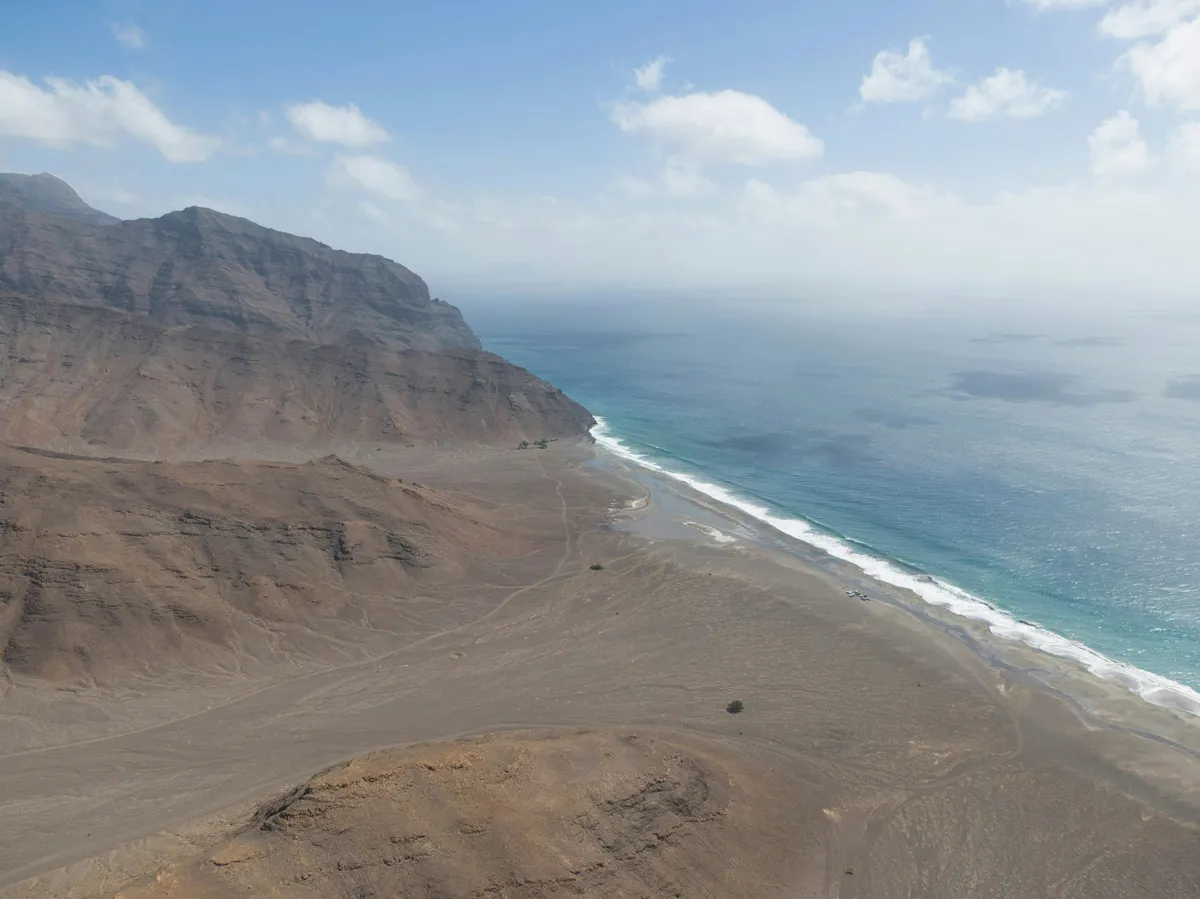
Arid mountains above a long empty beach on São Vicente, Cape Verde
Photo by Datingscout on Unsplash · Unsplash License