Cape Verde Currency and Money: Escudos, Euros, Cards and Cash
Cape Verde uses the escudo, pegged to the euro. Euros are widely taken on Sal and Boa Vista, Visa and Mastercard work on the Vinti4 network, and escudo exports are capped.
By Cape Verde 365 Editorial Reviewed by Alex Borshch, Founder & Editor
Published November 16, 2026 · 9 min read
Money in Cape Verde (officially Cabo Verde) is less complicated than it first looks. There is a local currency, the escudo, but it is tied to the euro, and in the resort areas of Sal and Boa Vista euros change hands every day. The details that catch people out are elsewhere: a fee to pay before you fly, a small allowance for taking escudos home, and cards that work well in some places and not at all in others. This guide uses official sources as read in November 2026 and says where we could not confirm something.
The escudo and its link to the euro
The official currency is the Cape Verdean escudo. Official sources use CVE or ECV for the currency; the consular fee table writes amounts in the form 3,400 $ 00. The US government's commercial guide states that the escudo is pegged to the euro while the escudo to US dollar rate changes daily. The peg comes from an exchange cooperation agreement between Portugal and Cape Verde established in 1998, so the escudo moves with the euro rather than floating against it.
The Banco de Cabo Verde states the fixed parity as EUR 1 = CVE 110.265. Its clarification on card conversion also explains that conversion services can carry an additional fee. The peg is not a guarantee of a fee-free transaction: check your bank's charges and the conversion offered before paying or withdrawing cash.
For travellers paying in pounds or dollars, the practical effect is simple: your costs in Cape Verde move up and down with your currency's rate against the euro.
The first payment: before you land
For travellers subject to pre-registration, use only the official platform, www.ease.gov.cv. FCDO advises British visitors to register at least five days before arrival, bring confirmation and check whether their tour operator handles it. As of November 2026, Decree-Law 49/2026 (in force since 4 November 2026) sets the airport security fee (TSA) at 4,400 escudos per international arrival, about EUR 39.90 at the official euro parity, and 200 escudos (about EUR 1.81) for domestic flights, collected when the domestic ticket is issued. The consular portal's FAQ still showed the older 3,400 and 150 escudos when we read it. Exemptions apply: children under two are exempt from TSA, and the consular portal also lists exemptions linked to Cape Verdean nationality, family ties, transit and official missions. Cape Verdean nationals and foreign residents are exempt from pre-registration; FCDO also exempts children aged one and under. From 1 July 2026, FCDO says travellers who have not pre-registered or cannot show proof must pay double the TSA at border control. Check whether TSA is included in your booking before paying separately. Our visa and entry requirements guide covers the steps.
Paying in euros
The US commercial guide says euros are widely accepted, particularly on the islands of Sal and Boa Vista. For stays in Santa Maria and Sal Rei, check the accepted currency with each business. Three practical points:
- Ask about change. Check the currency and exchange rate before paying in euros.
- Small notes help. Consider bringing smaller euro notes for small purchases.
- Away from the resorts, think escudos. On Santiago, Santo Antão, Fogo, Maio or São Nicolau, and in local markets, shops and minibuses everywhere, plan to pay in the local currency. The tourism institute recommends escudos for small purchases and market visits.
Cards and ATMs: the Vinti4 network
Cape Verde's card payments and cash machines run on a national network called Vinti4, operated by SISP. According to the US commercial guide, the Vinti4 network generally accepts Visa cards and Mastercard, both for payments at card terminals and at ATMs for cash withdrawals, and the fees for payments and withdrawals are set by your card issuer. SISP's own page on international cards names VISA, MasterCard and American Express acceptance, but does not say how widely American Express is taken, so carry a Visa or Mastercard as your main card.
What this means on the ground:
- Cash machines: withdrawing escudos from an ATM with a Visa or Mastercard debit card is the simplest way to get local cash. Check your bank's foreign transaction and withdrawal fees before you go.
- Card payments: hotels and larger restaurants in the resort towns usually take cards. Small cafés, beach bars, market stalls and taxis may not.
- Traveller's cheques: the US guide says they are not commonly accepted. Leave them at home.
- Check with your bank. Ask about card use abroad and any travel-notification requirements.
Check cash-machine locations before travelling to smaller towns or villages. If you are heading for the hiking trails of Santo Antão or Chã das Caldeiras on Fogo, take enough escudos with you from a town.
Cash limits when you arrive and leave
The airport operator, Cabo Verde Airports, publishes the rules on carrying money. As of November 2026 its page says:
| Situation | Rule |
|---|---|
| Arriving with foreign currency over 1,000,000 escudos | Declare it to the border police in order to use the money freely |
| Taking escudos out of the country | Up to 20,000 escudos in notes and coins per person per trip; more needs prior authorisation from the Banco de Cabo Verde |
| Non-residents leaving with foreign currency | Up to 1,000,000 escudos' worth, plus cards and cheques issued abroad |
| Non-residents leaving with more | Proof that you brought the money in or bought it from an authorised exchange (for example a customs-stamped entry declaration) |
One million escudos is far more than a holiday budget, so most visitors will never come close. The limit that matters is the 20,000 escudo cap on taking local currency out. The export cap is reason enough to plan on getting escudos after you land and to spend or change most of them before you fly home.
As of November 2026, the same operator says non-commercial goods worth up to 15,000 escudos enter duty-free, and the UK government warns that you must declare anything that may be prohibited or subject to tax or duty.
Changing money
As of November 2026, the airport page warns that buying currency outside authorised exchange entities (banks, exchange offices) can lead to a fine of 10% to 100% of the amount seized. Use banks or authorised exchange offices. If a hotel offers exchange, check that it is authorised. Keep the receipts if you change large sums.
Tipping
We did not find an official Cape Verdean source on tipping, so treat this as general guidance rather than a rule. Do not assume a fixed tipping percentage. Check whether a service charge is already on the bill. Where it is not, rounding up or leaving a small amount for good service in a restaurant, or for a guide after a turtle-watching night or a whale-watching trip, is an optional choice. Ask which currency is preferred.
What things cost, in words
Compare current menus and operator quotes when setting your budget. The tourism institute publishes broad examples, but these are not guaranteed prices for a particular business.
- All-inclusive resorts on Sal and Boa Vista can help you plan spending: check what is included and budget separately for excursions, drinks outside the hotel and souvenirs.
- Excursions: allow a separate budget. Kitesurfing lessons, scuba diving, desert and dune tours and boat trips should be compared using current operator quotes.
- Local food: compare a plate of cachupa in a local café with grilled lobster (lagosta grelhada) on the menu before choosing.
- Drinks: try local grogue and ponche rather than imported spirits.
- Island hopping adds up: domestic flights and ferries are a real line in the budget. See our island-hopping guide.
In towns such as Praia and Mindelo, local cafés and markets give you a feel for everyday prices outside the resort bubble.
Keeping your money safe
The UK government's advice is to leave valuables somewhere secure, such as a hotel safe, and to avoid carrying large amounts of cash or wearing expensive jewellery. It notes pickpocketing, bag snatching and muggings, particularly in Praia and on Sal and Boa Vista. Carry one card and a day's cash, keep a second card in the safe, and use ATMs inside banks or hotels in daylight where you can. See is Cape Verde safe for the full advice.
Money checklist
- Check your exemptions and booking inclusions, then pre-register and pay any TSA due on www.ease.gov.cv. Keep the confirmation.
- Pack a Visa or Mastercard (two if you can, kept separately) and tell your bank.
- Bring some euros in small notes for arrival and tips.
- Withdraw escudos from an ATM once you land if you are leaving the resort.
- Declare foreign cash over 1,000,000 escudos' worth on arrival (rare for holidaymakers).
- Spend or change escudos before leaving: the export allowance is 20,000 per person.
For more planning help see local tips, things to do in Cape Verde and our 7-day Sal itinerary.
Frequently Asked Questions
What currency is used in Cape Verde?
The Cape Verdean escudo (CVE, also written ECV). The fixed parity is EUR 1 = CVE 110.265. The exchange cooperation agreement with Portugal dates to 1998.
Can I use euros in Cape Verde?
Yes, widely on Sal and Boa Vista, according to the US government's commercial guide. Check acceptance and the currency of change before paying. Carry escudos for small purchases and market visits, as the tourism institute recommends.
Do cards work in Cape Verde?
Visa and Mastercard generally work on the national Vinti4 network, for card payments and at ATMs. SISP, which runs the network, also names American Express, but carry a Visa or Mastercard as your main card. Check card acceptance before ordering or travelling.
Should I buy escudos before I travel?
Consider withdrawing escudos after arrival and bringing some euros for initial expenses. Official rules limit taking escudos out of Cape Verde to 20,000 per person per trip, so do not plan to bring large amounts home either.
How much cash can I bring into Cape Verde?
The airport operator says foreign currency over 1,000,000 escudos' worth must be declared to the border police on arrival. Holiday amounts are far below that. If you do declare, keep the stamped declaration so you can take the money out again.
Do you tip in Cape Verde?
We found no official guidance establishing a tipping amount. Treat it as an optional choice. Check the bill for a service charge first. Rounding up in restaurants and giving a little to guides and drivers after good service is one option.
Is Cape Verde expensive?
It depends where you eat and what you book. Compare restaurant menus and excursion quotes on Sal, Boa Vista, Praia and Mindelo for your own budget. Island hopping by plane or ferry is a significant cost.



Photo gallery
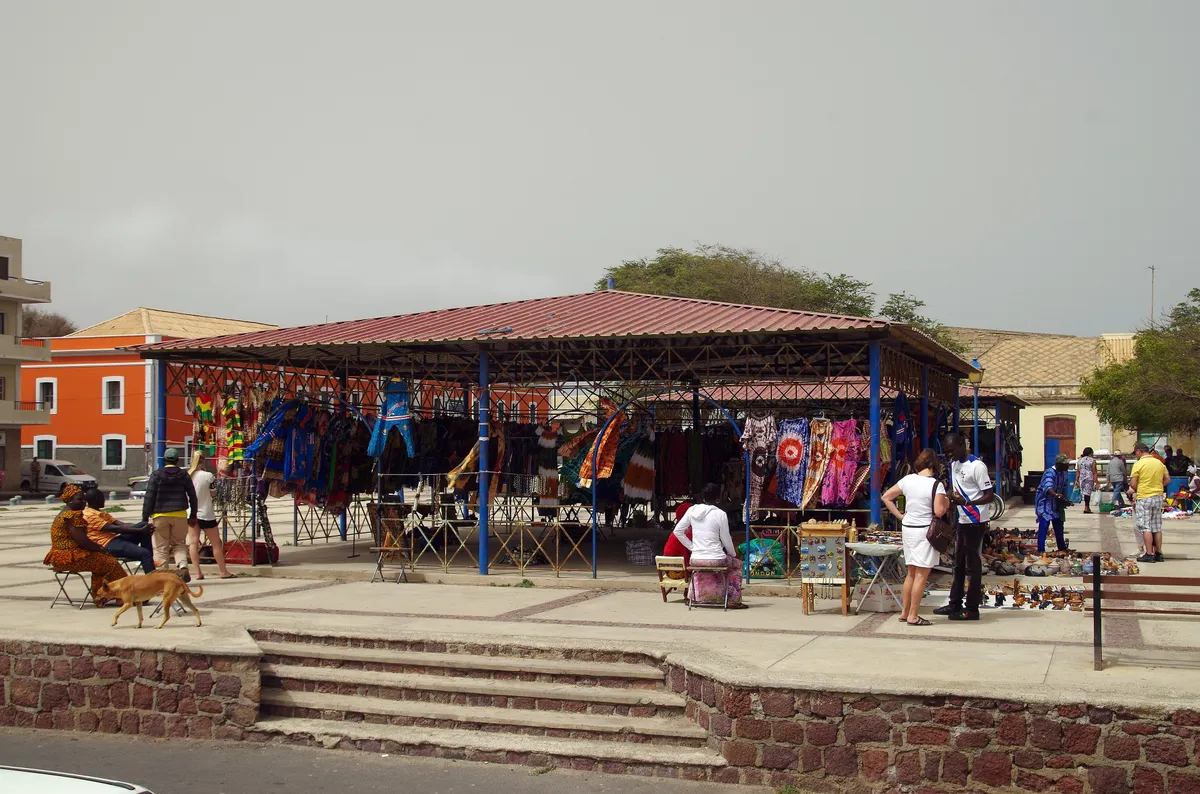
Craft and clothing market stalls on Praça Estrela in Mindelo
Photo: Balou46 via Wikimedia Commons · CC BY-SA 4.0 (https://creativecommons.org/licenses/by-sa/4.0)